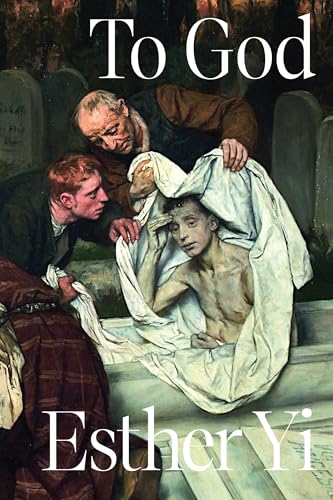
Esther Yi, author of acclaimed debut novel Y/N (shortlisted for The Center for Fiction First Novel Prize 2023), has returned with To God, a stunning collection of surrealist prose. This is not a series of distinct short stories; each piece is connected and cohesive, blending together with no clear boundaries. The narrators are unnamed and largely unknown to us—sometimes despairing writers, mostly female, always grappling with an overwhelming sense of loneliness.
The opening story, Author Biography (No Picture), opens with a woman explaining her mother had fainted while giving birth, leaving her lying alone as a newborn for her first existing moments. “For the first hour of my life, no one was aware of me but myself. That may be why I never knew how to be alone as a child.” This sets the stage for the core themes of To God and is as close to understanding our narrator as we ever get.
These stories lean harder into the abstract as reality progressively begins to fracture. In Mutter, a woman employed at a zoo brings her mother to visit the only Californian condor left in the world. In Akey a father lives with his daughter in the woods and steals dogs. Mister’s Wound follows a construction worker’s reaction to a severe injury while on the job. In Author Biography (No Picture), a woman is hired to describe the moon to people born without faces. In No Right Hand, a woman trades places with a nun after losing her right hand. The standout piece in this collection, Dent, features a Black Mirror-esque dystopian company providing a way for customers to relive their happiest moments. In a bleak kind of modern fairy tale set-up, the company attempts to help their newest client help find love.
There is another common link at the core of these stories: someone is clinging to a relationship, no matter how shallow and unfulfilling it might seem. There’s an eerie, uncanny valley feel to each character the narrator encounters; they feel almost like virtual avatars, a little inhuman and distant. You can find a recurring theme of wanting more, of yearning for something out of reach, of fleeting moments of hope and desperate attempts to interact with something outside of oneself.
There’s a stark, eerie feeling that permeates each story. Distanced from the world, the narrator has been abandoned not just by people, but by God himself. The narrators’ questions are left unanswered by God; failing to find him, they seek answers elsewhere—from novice nuns, their parents, their children, boxers, construction workers and faceless beings. Is humanity decaying? What is befalling our world? What are we building and what is it for? Is there anyone else out there? How do you describe the moon to someone who has never seen it? These questions are called out into empty space, with this great absence so overwhelming in these stories that it takes on a shape of its own.
To God is set in a modern hellscape, a pure dystopia. The recurring setting of construction sites builds on— pun intended— the sense that the characters in To God are dedicating themselves to something empty and devoid of meaning. In Sumo’s Picture, a memorial is constructed to commemorate tragic events that haven’t happened yet. The only thing missing is “the bodies as its finishing touch.” There’s always a new building being constructed, and the city expands and grows. A map of the city is updated every hour to account for new additions. Meanwhile, the residents seem to wither away, flickering in and out of reality. “Physically, I’d shriveled away, becoming smaller and smaller like a dot, until I vanished from the page of my own life.” Still, the construction continues as the city “decays upwards.”
Our characters are desperate for love, disconnected and alienated from the world around them, yet persistently hopeful: “For all the shoddiness of my soul, I’m capable of having beautiful visions at night.” In the final story Akey, the narrator’s love for his daughter keeps him moving forward. These characters are battling to reject the artificial and seek out something genuine. They defy the isolation they have been cornered into.
“There’s a secret inscribed into the face of the universe,” advises the novice nun in No Right Hand. While the narrators cannot find God—and, arguably, are playing God as they build their towers and ‘future memorials’, manufacturing memories of love—they continue to pursue connection, answers and purpose. The seek for answers and yearning is what drives these stories.
As reality warps around the narrator over the course of To God, looking past the abstract becomes impossible. It can be hard to follow the writing at times, but don’t be intimidated. It’s easy work to get lost in and it rewards a reader who can read between the lines and the empty spaces between each story. Your only way of traversing this surreal dystopian world is to trust the process and let the vignettes guide you forward; the harder you try to make sense of things the more the meaning slips out of reach, like a dream the narrator is progressively forgetting.
It’s been a pleasure to engage with To God for the reason that it does demand your full attention. Esther Yi’s writing voice is easy to admire – strong, distinct and lyrical, she is a master of her craft; each line feels so carefully considered and placed so deliberately. It’s not often you come across something so original in style and so compelling in its storytelling, and being absorbed in her world has been an absolute gift. She has managed to not only meet but exceed the expectations set by her debut novel, which is a feat all of its own. She has pushed the boundaries of language and form in To God to create something difficult to define and fascinating to behold.
From the author of the acclaimed debut novel Y/N, a daring collection of fiction about alienation, sex, and spiritual inquiry.


Leave a Reply